

1. EXECUTIVE SUMMARY
The ‘hard’ home services sector, defined by non-discretionary mechanical and electrical trades (HVAC, Plumbing, Electrical), has officially transitioned from a fragmented collection of local operators into a sophisticated asset class. As of Q1 2026, private equity continues to be the dominant driver of M&A activity. However, the strategy has shifted from broad platform creation to local geographic density and technological integration.
In a market defined by economic changes over the last few years, home services have remained a premier target for institutional capital due to their recession-resistant nature and high barriers to entry.
2. MACRO-ECONOMIC FUNDAMENTALS
The U.S. home services market is projected to reach $842 billion by the end of 2026. Unlike ‘soft’ services (landscaping, cleaning) which face discretionary spending cuts, hard services are underpinned by a non-negotiable demand cycle.
- The Aging Housing Super-Cycle: The median age of the American home has surpassed 40 years. For the first time, more than 50% of the domestic housing stock is in a high-maintenance zone.
- The Lock-In Effect: With mortgage rates stabilizing at higher levels than the previous decade, the move up market has stalled. Homeowners are choosing to renew in place, redirecting relocation budgets into substantial system upgrades.
- Climate Volatility: Increasing frequency of extreme weather events has transformed HVAC from a comfort luxury into a critical utility, driving urgent and high-margin emergency service demand.
3. THE PRIVATE EQUITY PLAYBOOK
Consolidation in 2026 has moved beyond simple financial engineering. Leading PE firms are now utilizing a Center of Excellence model to professionalize their acquisitions.
3.1 The Hub-and-Spoke Strategy
Investors are building Super Regions to maximize logistical efficiency:
- Logistical Density: By acquiring 10–15 add-ons within a 50-mile radius, platforms are slashing unproductive truck time by 18%.
- Cross-Trade Synergy: The most successful 2026 platforms are multi-trade. Capturing the whole home allows for a 30% higher customer lifetime value (CLV) compared to single-trade operators.
3.2 The Membership Economy
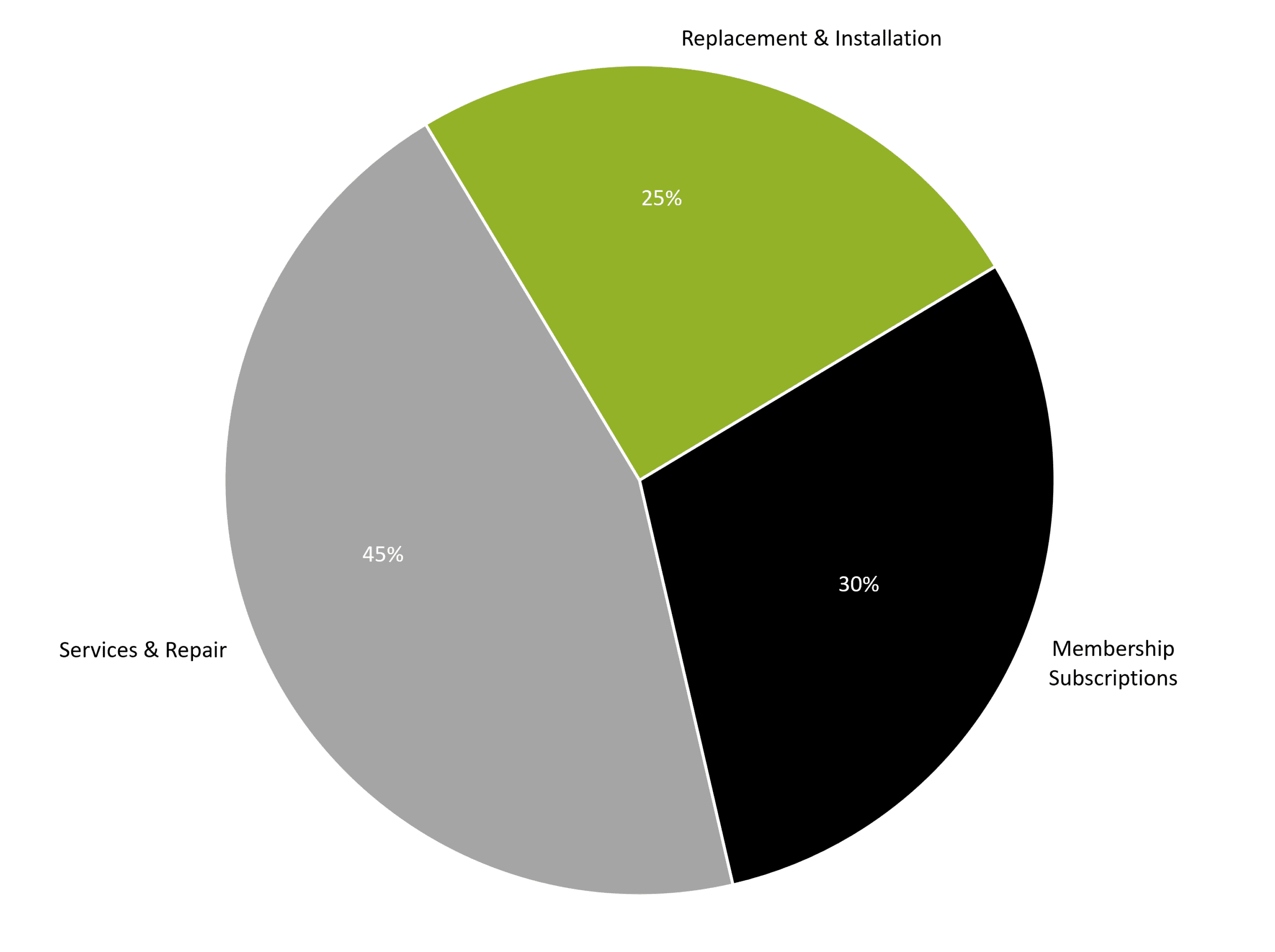
The holy grail of 2026 valuations is recurring revenue. PE-backed firms are aggressively pivoting toward subscription models. These memberships now account for nearly 28% of total revenue for top-quartile firms, providing a predictable cash flow floor.
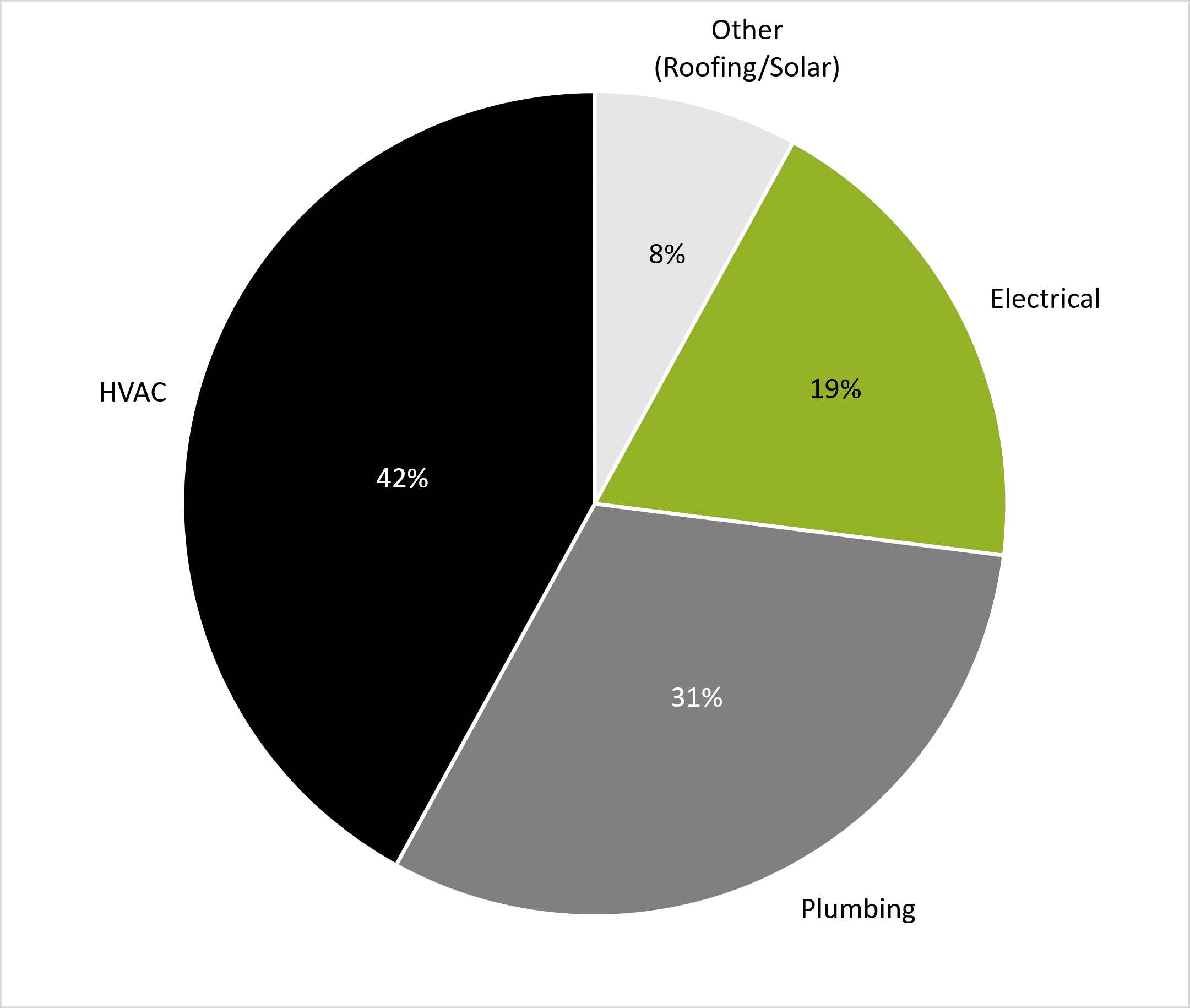
Private Equity Investment Focus by Trade (2026)
4. 2026 VALUATION LANDSCAPE
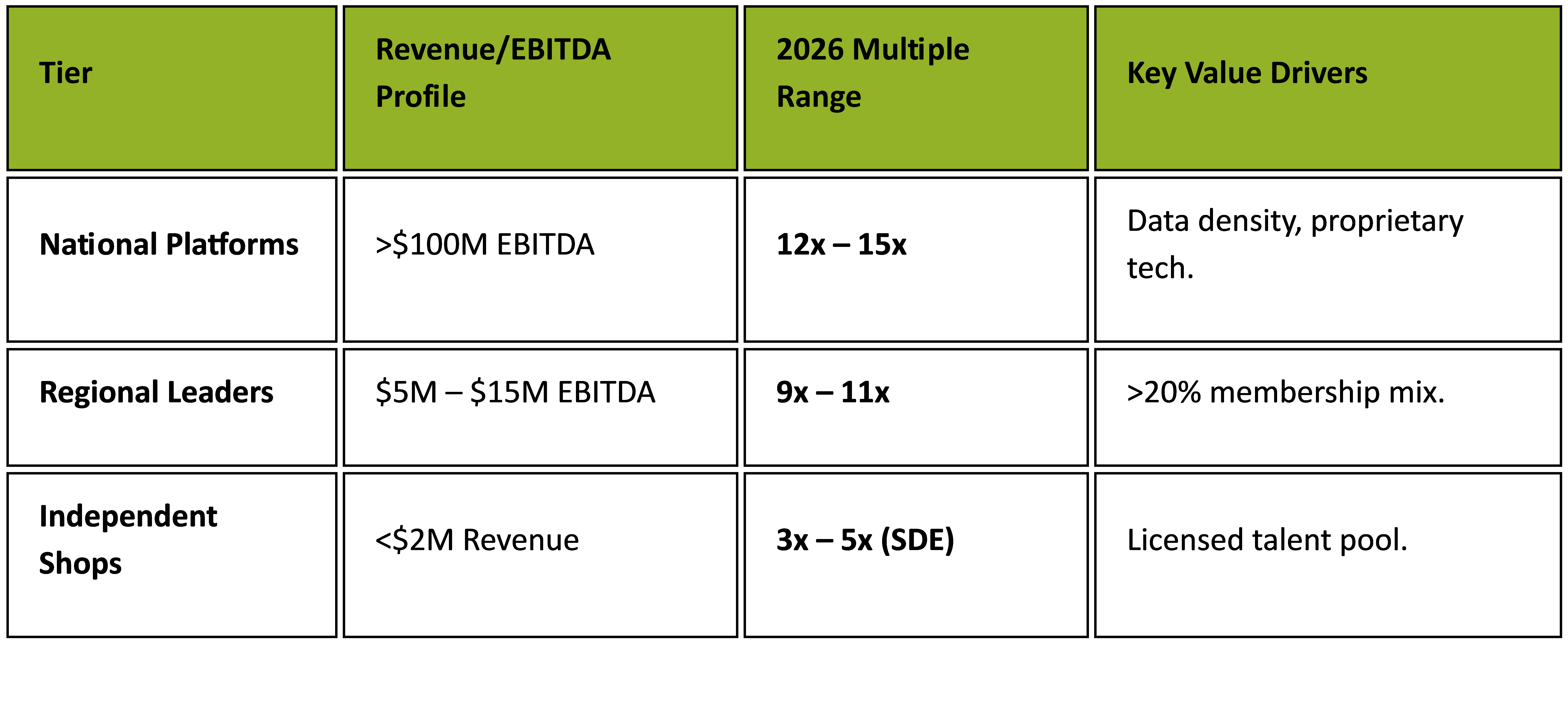
The M&A market is currently experiencing a K-shaped valuation split. Quality assets are seeing multiple expansion, while lower quality assets are being acquired at significant discounts.
Estimated Valuation Multiples (Q1 2026)
Target Revenue Mix for 10x+ EBITDA Valuation (2026)
5. TECHNOLOGICAL CATALYSTS
In 2026, the primary differentiator between a 7x and a 12x business will be the Tech Stack.
- Integrated Operating Platforms and Accounting Systems: Scaled platforms have systems that are integrated with each other creating automated workflows and more accurate data.
- Agentic AI Dispatching: Scaled platforms have replaced human dispatchers with AI agents that analyze real-time traffic, technician skill levels, and job profitability.
- IoT-Enabled Predictive Maintenance: Smart HVAC and water heaters now alert the central platform of failure before the homeowner notices, turning an emergency repair into a planned maintenance event.
- Virtual Estimates: Using LiDAR on smartphones, technicians generate 3D home models and instant quotes, reducing the sales cycle from days to minutes.
6. WORKFORCE & LABOR DYNAMICS
The industry faces a deficit of 110,000 licensed technicians in 2026. This shortage is a primary driver of consolidation.
- The “Acqui-hire” Premium: Larger firms are buying smaller shops primarily to “harvest” their master plumbers and electricians.
- Institutionalized Training: PE-backed platforms are building internal Trade Academies. By offering clear career paths and 401(k) matching, these giants are winning the war for the next generation of tradespeople.
7. REGULATORY & ENVIRONMENTAL COMPLIANCE
The 2026 landscape is complicated by the Refrigerant Transition. The phase-out of traditional refrigerants in favor of low-GWP (Global Warming Potential) alternatives has increased equipment costs by 15%.
Winner’s Advantage: Large platforms have the capital to pre-buy inventory and train entire fleets, while smaller operators face supply chain bottlenecks.
8. STRATEGIC OUTLOOK AND CONCLUSION
The consolidation of hard home services is entering its mature phase. The next 18 months will see a ‘roll-up of the roll-ups’, as mid-market PE firms sell their regional platforms to global mega funds.
For owners, 2026 is the year to professionalize or exit. The window for high-multiple exits is open for those with clean data and recurring revenue, but it is rapidly closing for those still operating on legacy analog models.
Appendix: 2026 Due Diligence Considerations
1. FINANCIAL INTEGRITY & REVENUE QUALITY
The most immediate red flags in 2026 involve earnings that look strong on paper but are structurally unstable.
- Owner Operator If the founder is still the primary salesperson or the only one holding key vendor relationships, the business is viewed as “un-transferable.” This often leads to a 20–30% discount or a heavy earn-out structure.
- Poor Revenue Mix: A heavy reliance on ‘one-off’ emergency calls vs. recurring maintenance agreements. In 2026, if membership-driven revenue is below 15%, the asset is considered “high-volatility.”
- Unvetted Financials: Presenting unaudited or inaccurate financials. Buyers in this cycle have zero tolerance for EBITDA that cannot be backed by clean, third-party verified data.
2. HUMAN CAPITAL & LABOR RISK
With the 2026 technician shortage at record highs, Human Capital is the most scrutinized asset. With a deficit of 349,000 to 439,000 net new workers needed in 2026, labor is the primary constraint on growth.
- High Technician Churn: An annual turnover rate exceeding 20% is a major red flag. It indicates a toxic culture or a lack of competitive benefits, which will make post-acquisition scaling impossible.
- The Aging Workforce Gap: A roster where the majority of master-licensed technicians are within 5 years of retirement without a clear “Apprenticeship Pipeline.”
- Misclassification of Contractors: Using 1099 contractors for roles that should be W-2 employees. In 2026, the Department of Labor has increased audits; this “hidden liability” can lead to massive post-close legal settlements.
3. OUTDATED TECH PROBLEM
A newer red flag is the presence of outdated Tech or unmanaged AI.
- “Shadow AI” Usage: Employees using unapproved AI tools to handle customer data or pricing. This creates massive data privacy and security risks that PE firms will not touch without heavy indemnification.
- Outdated Tech Stack: Reliance on “Legacy” software that does not allow for API integrations. If the business cannot feed real-time data into a PE firm’s “Center of Excellence” dashboard, it is viewed as a “fixer-upper” rather than a platform.
- Fragmented Data: Customer records that are incomplete, duplicates, or stored in physical files. Buyers are looking for “Data Hygiene” to fuel their predictive maintenance models.
4. REGULATORY & ENVIRONMENTAL COMPLIANCE
As of March 2026, environmental compliance has become a binary deal-breaker.
- Refrigerant Non-Compliance: Failure to document the transition to low-GWP refrigerants (mandated by the EPA Technology Transition Rule). If a firm cannot prove its technicians are certified in the new 2026 standards, the deal is often paused.
- Permit & Licensing Gaps: Lapsed municipal licenses or a history of unpermitted installs. Consolidated platforms are “litigation magnets,” so they will not inherit a company with a history of cutting regulatory corners.
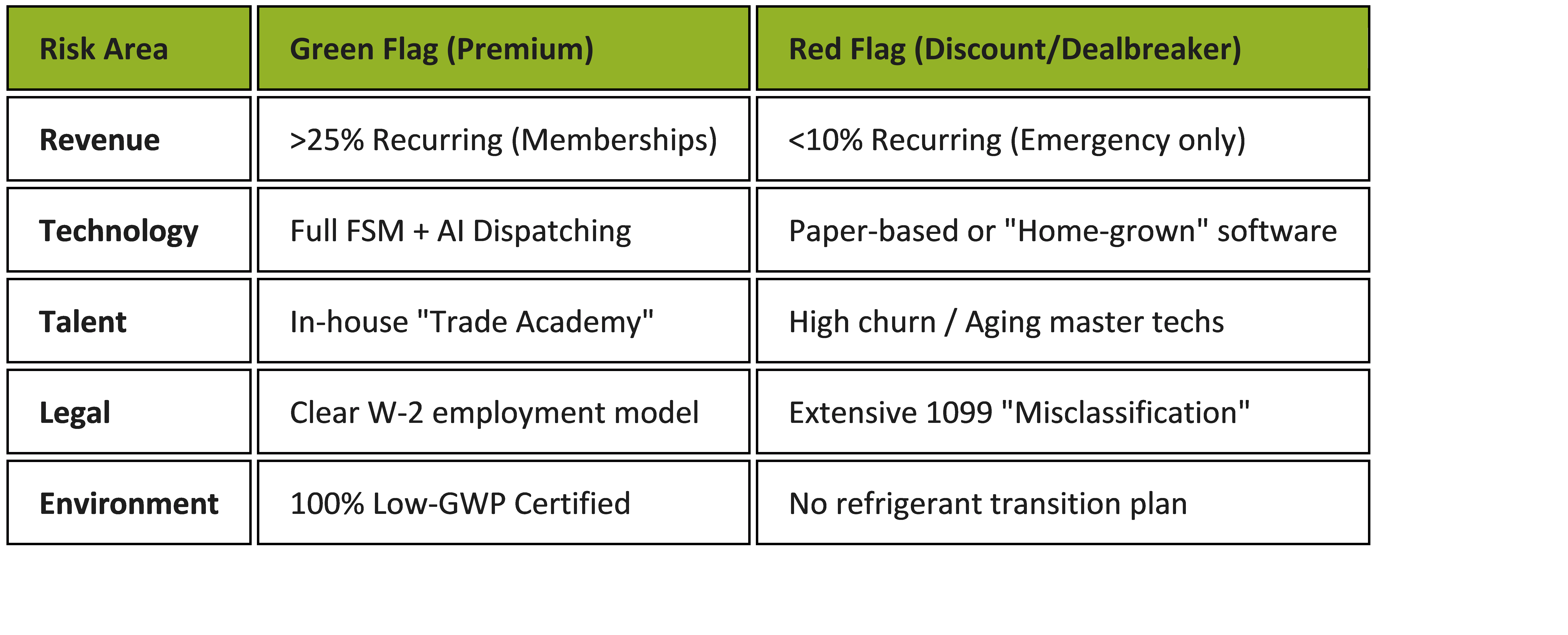
DUE-DILIGENCE READINESS SCORECARD
Use the following table to self-assess your risk profile before going to market:
Sources:
Market Intelligence & Sizing
Grand View Research. (2026, February). U.S. HVAC systems market size, share & trends analysis report by product, by end-use, by region, and segment forecasts, 2026–2033. https://www.grandviewresearch.com/industry-analysis/us-hvac-systems-market
Jobber. (2026, February 27). 2026 home service trends report. https://www.getjobber.com/home-service-trends-report/
Mordor Intelligence. (2026, January). United States home services market – Size, share & industry analysis (2026–2031). https://www.mordorintelligence.com/industry-reports/united-states-home-services-market
The Business Research Company. (2026, February). Plumbing, heating, and air-conditioning contractors global market report 2026. https://www.thebusinessresearchcompany.com/report/plumbing-heating-and-air-conditioning-contractors-global-market-report
Harris Williams. (2026, January 23). 2026 industry outlook: Business services M&A trends. https://www.harriswilliams.com/our-insights/bs-2026-industry-outlook-m&a-trends-business-services
Private Equity & M&A Trends
Brookfield Asset Management. (2026, January). Private equity outlook: Resilience, reset, and resurgence. https://www.brookfield.com/insights/private-equity-outlook-2026
PwC. (2025, December 16). Private equity: US deals 2026 outlook. https://www.pwc.com/us/en/industries/financial-services/library/private-equity-deals-outlook.html
Labor & Workforce Dynamics
Associated General Contractors of America. (2026). 2026 construction and skilled trades workforce survey analysis. https://www.agc.org/workforce-survey-2026
Linxup. (2026). Plumbing industry statistics and trends: 2026 report. https://www.linxup.com/resources/plumbing-industry-trends-2026
Regulatory & Technology Standards
U.S. Environmental Protection Agency. (2024, December). Technology transitions program: Labeling products and equipment that use hydrofluorocarbons (HFCs) [Fact Sheet]. Office of Air and Radiation. https://www.epa.gov/system/files/documents/2024-12/labeling_factsheet_12-2024.pdf
U.S. Environmental Protection Agency. (2026, February 24). Technology transitions GWP reference table. https://www.epa.gov/climate-hfcs-reduction/technology-transitions-gwp-reference-table